We will be closed Saturday (1/24) - Monday (1/26) due to inclement weather.

This is part three of our Garden Design 101 Series, designed to help Northwest Arkansas gardeners plan with intention and build their best gardens yet.
We've talked about depth—building layers that give your garden dimension. We've talked about seasonality—choosing plants that carry the garden through every month of the year. Now it's time to talk about the design principle that is what cleans everything up: structure and repetition.
This is the one that makes a garden feel like it was designed, not just planted.
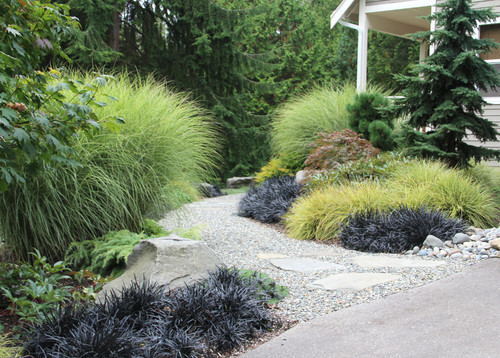
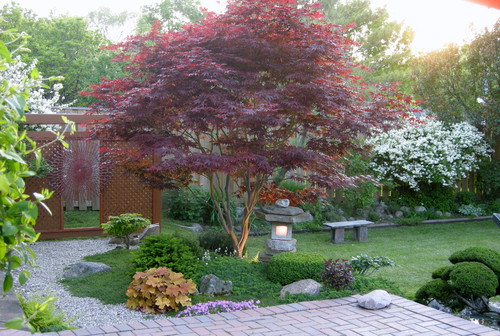
Walk through a garden that feels calm, finished, and impressive. Chances are, you're not noticing the flashy annuals first. You're responding to the bones: the shrubs and grasses that give the whole space a sense of weight and order.
These plants do something that perennials and annuals can't: they show up consistently. A well-placed shrub looks good in April and in November. Ornamental grasses add movement in summer and stunning presence in winter. They don't need to bloom to earn their place. They provide backdrop—a visual anchor that makes everything in front of them look better by comparison.
Without structure plants, a garden is just a collection of things that happen to be growing near each other. With them, it becomes something that feels complete.
Think of shrubs and grasses as the walls and furniture of your outdoor room. The perennials and annuals are the accessories. Accessories are great, but you need the room first.
Here's a mistake we see constantly: a gardener falls in love with a lot of different plants and buys one of each. The result is what we sometimes call a "collector's garden." Interesting up close, chaotic from a distance.
Randomness can feel exciting while you're shopping. But once plants are in the ground, the eye doesn't know where to go. There's no rhythm, no rest, just noise. If you like that choas, you do you! But if you like a garden that feels more clean and visually pleasing, then you need some repeating plants.
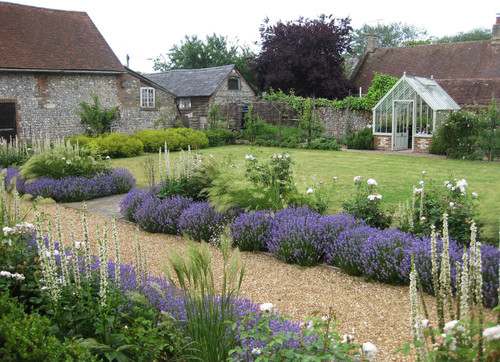
Repetition is what creates calm.
When you repeat a plant—or even just a color or texture—across a bed, the eye has something to follow. It creates a visual thread that pulls the whole garden together. The repeated element doesn't have to be identical each time. You might use the same ornamental grass in three different spots, or repeat a purple-foliaged plant in different varieties. The similarity is what matters.
This is also how professional designers make a garden feel larger than it is. Repetition creates a sense of intention and pattern that your eye can follow.
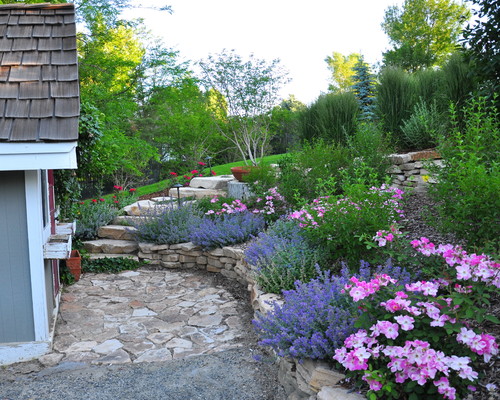
A single plant rarely makes an impact. Three plants make a statement. Five make a scene.
This is hard to internalize when you're standing in a garden center holding a beautiful specimen. You want one of everything. But a lone coneflower in a border disappears. Three coneflowers planted together become a focal point. Seven become a drift you can see from across the yard.
Grouping accomplishes a few things at once:
Groups don't have to be perfectly uniform. Slightly irregular groupings look more natural, but keep them close enough that they read as one unit rather than scattered individuals.
You don't need to overthink grouping. A few simple guidelines:
Plant in odd numbers. Groups of 3, 5, or 7 look more natural than even-numbered plantings. The eye doesn't settle the same way with even numbers, there's always a "center" that wants to exist, and odd numbers let that happen naturally. There's a common design rule that professionals use called "the rule of three". It works.
Keep groups together. It sounds obvious, but plants meant to be grouped often end up spread across a bed "to fill space." Resist that. A tight group of 5 plants is more effective than 5 plants scattered to cover ground.
Repeat the group. If a grouping works in one part of the bed, place a similar grouping elsewhere—perhaps on the opposite end, or near a focal point. This is how you build rhythm across the whole garden.
Scale the group to the bed. A small border might call for groups of 3. A large foundation planting might need groups of 7 or more before they read clearly. Step back and look. If the group still feels small from your main viewing spot, you probably need more.
This is another common mistakes in garden design.
A shrub at the garden center is small, tidy, and easy to imagine fitting anywhere. So you plant it 18 inches from the house, 12 inches from its neighbor, and right in front of a window you love. Five years later, you're pruning constantly, blocking your own view, and fighting a plant that is fighting back!
Always design for mature size, not planted size.
Every plant tag tells you how large a plant will get. Trust it. If a shrub is listed at 5 feet wide, give it 5 feet. It will fill that space...although many plants you can prune to keep in check, you still want to plan for the full size.
This has a few practical implications:
Spacing feels awkward at first. When you plant for mature size, gaps are inevitable early on. Annuals are your best friend here—use them to fill space while perennials and shrubs establish. Don't be tempted to squeeze structural plants together just to make things look full on day one.
Smaller plants in front. Obvious, but easy to forget when you're excited about a new shrub. Mature height matters for layering. A shrub that tops out at 3 feet belongs in the foreground or midground. A 6-foot viburnum belongs in the back.
Scale to your specific space. A dwarf variety might look right at home in a tight courtyard and disappear in a large landscape. A bold ornamental grass can anchor a big bed beautifully and feel completely out of place in a small foundation planting. Always consider the plant in relation to your space, not just in isolation.
A helpful exercise: sketch your bed from above, draw circles at the mature diameter of each plant, and see how things fit. It takes five minutes and can save years of corrective pruning.
Structure and repetition aren't glamorous concepts. They won't get you excited the way a new rose variety or a rare perennial will. But they're the reason some gardens stop you in your tracks.
The formula is straightforward: start with structural plants that create a backdrop, repeat your best performers across the bed, group plants for mass and impact, and always design for mature size.
Do those four things, and your garden won't just look like it was planned by a professional.
In the next article in our Garden Design 101 Series, we'll keep building on these fundamentals. In the meantime, stop by any of our four Northwest Arkansas locations and talk through your design with our team—we love this stuff.